The history of corneotherapy is best understood as a progression of scientific thought over the past 60 years, evolving from an early concept into a globally recognised clinical approach, supported by multiple disciplines including dermatology, biophysics and biochemistry.
Indeed, the International Association for Applied Corneotherapy is not founded on the work of any single individual. It is grounded in the term itself and the body of research that has developed around it.
As with many scientific terms, its origins are referenced through the literature in which it appeared, including the publication by N. Tabata, K. O’Goshi, Y. X. Zhen, A. M. Kligman and H. Tagami (2000), which evaluates corneotherapeutic principles in practice.
Subsequent decades have seen significant expansion in our understanding of the skin. The stratum corneum is now recognised not as a passive layer, but as a dynamic and functional structure central to barrier integrity, immune interaction and overall skin health. This shift has been driven by the work of many researchers and clinicians across disciplines.
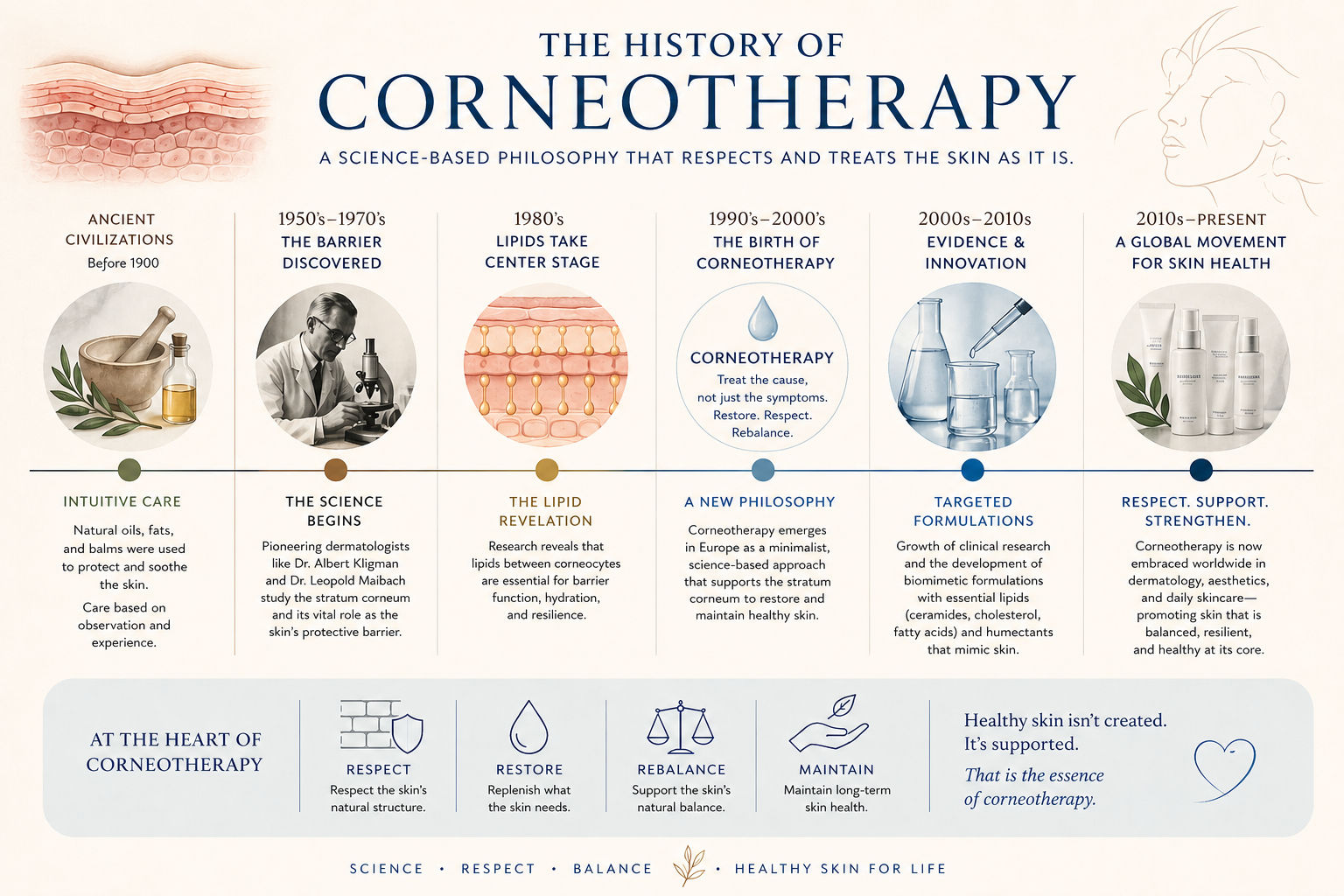
Modern corneotherapy is the result of this collective progression. Its development has been shaped by contributions from leading scientists, including Peter M. Elias, Ronald Marks, Hachiro Tagami, Anthony Rawlings, and Lars Norlén, among others.
Their work has been instrumental in advancing our understanding of epidermal biology, barrier function and skin physiology, helping to shape corneotherapy into a clinically relevant and evidence-informed approach.
In its modern form, corneotherapy describes preventative and progressive strategies focused on restoring and maintaining the integrity of the stratum corneum. Central to this is the use of formulations designed to support and mimic the skin’s natural structure and function, demonstrating that targeted barrier repair can lead to meaningful clinical outcomes.
The continued emergence of related disciplines such as corneobiology and corneobiochemistry further reflects the depth and breadth of this field. These areas reinforce that corneotherapy is not static, but part of an evolving scientific landscape driven by ongoing research and interdisciplinary collaboration.
Modern corneotherapy is the result of decades of shared scientific endeavour. Its strength lies in this collective evolution, one that continues to inform both current practice and future direction.