By Dr. Hans Lautenschläger
Skin care customers are eager to avoid wrinkles, which is why they readily purchase various anti-ageing skincare products. These products are meant to effectively prevent the ageing of skin, but with today’s level of understanding about skin health, empty claims or fleeting promises are insufficient.
Recent advancements in the development of cosmetic products have significantly enhanced available treatment options. Media portrayals increasingly feature individuals over 50 who appear remarkably youthful, contributing to the impression that signs of ageing are diminishing.
However, regular self-observation, such as examining one's reflection during daily routines, affirms that the ageing process persists. This prompts further inquiry into the efficacy and mechanisms of anti-ageing products and their potential outcomes.
Exaggeration and pretension?
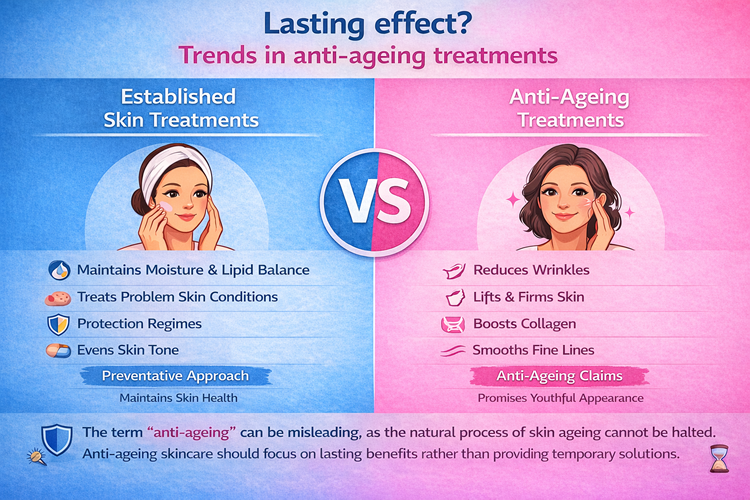
Most anti-ageing products fulfill their intended cosmetic function, which involves enhancing and improving appearance. In addition to their coverage, certain pigments can minimize the visible appearance of wrinkles through diffuse reflection of light. Hyaluronic acid provides a cushioning effect for the skin, while muscle-relaxing peptides and specialized extracts can help diminish fine lines. These are just a few examples within this rapidly evolving product category.
Strictly speaking, the term "anti-ageing" is not accurate when referring to these products, since they do not actually stop or reverse the process of ageing. However, it's important to clarify that these so-called effect products are valuable because they can temporarily enhance the skin's appearance.
Still, it’s worth asking: do any of these products deliver true anti-ageing effects, and where do lasting results truly begin?
The phrase "anti-ageing" is appealing, but the real goal should be to prevent premature skin ageing. Reversing biological ageing or erasing visible signs of time is simply impossible. The key is to start preventive measures against ageing as early as possible, an area where significant progress has been made.
Conflicting objectives
Reviewing past developments provides valuable insights for predicting future trends. Initially, it is important to examine cream bases, which serve as the matrix for active agents. Closely associated with these are the concepts of skin protection and recovery, as cream bases should be formulated to optimise both protective and restorative effects for the skin.
Dermatological research shows that while applying a film of vaseline, paraffin, or camouflage can provide maximum skin protection, it actually hinders natural skin recovery over time. Because long-term skin health depends on optimal natural recovery, compromises must be made regarding protective measures.
This realization led to the creation of physiologically adapted cream bases—skin barrier-like structures designed to repair the skin using substances naturally produced by the body or similar compounds, without forming an obstructive surface film. This approach helps restore trans-epidermal water loss (TEWL) without excessively reducing it. The development of these systems began about 25 years ago and continues to grow steadily.
Corneotherapy
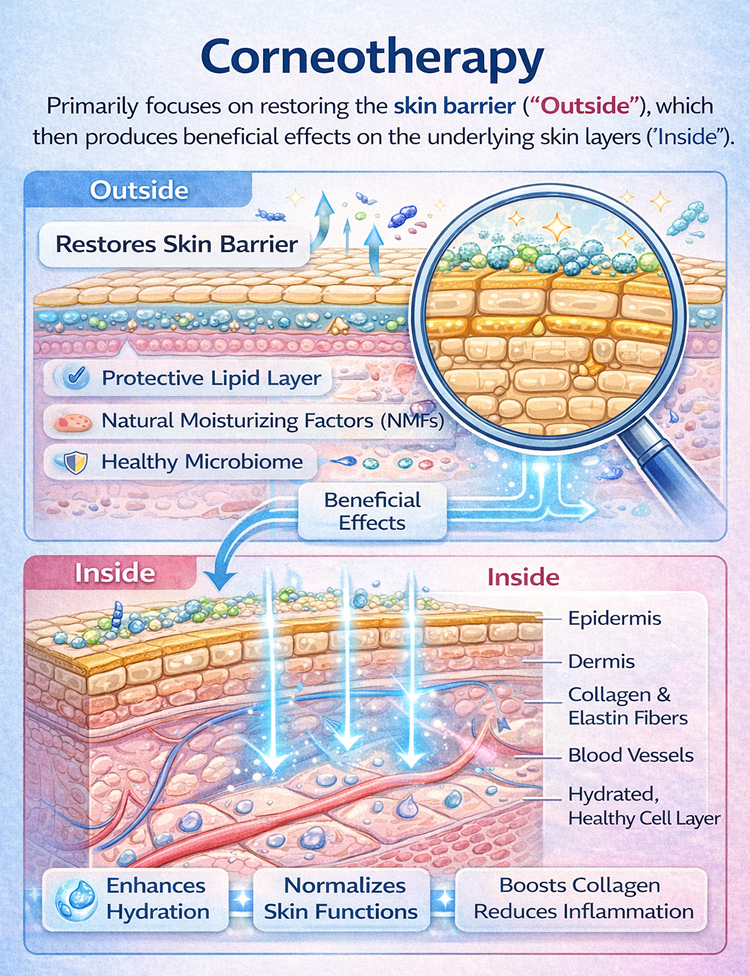
Concurrently, Professor Kligman introduced the concept of corneotherapy. His outside-in-therapy theory has been substantiated by subsequent research and is now regarded as a fundamental approach in preventing problematic skin, particularly when used alongside physiological cream bases. Corneotherapy primarily focuses on restoring the skin barrier (“outside”), which then produces beneficial effects on the underlying skin layers (“in”).
It is anticipated that these emulsifier-free formulations will ultimately supersede conventional skincare products.
Properly balanced skin protection
Effective skin protection is essential in corneotherapy, with sun radiation defence serving as a key component. Utilizing suitable UV-A and UV-B filters not only shields the skin from harmful effects but also provides significant anti-ageing benefits. Despite these measures, individuals with high sun exposure may still require additional safeguards. Infrared (IR) radiation also impacts the skin; however, no filter substances currently exist to counteract its effects, and future solutions remain uncertain. Besides using available products, it is advisable to seek shade as a precautionary measure.
To prevent ongoing skin stress, it's best to avoid using day creams with UV filters continuously. This allows the skin to naturally produce vitamins D2 (ergocalciferol) and D3 (cholecalciferol) without interruption.
The NMF (natural moisturizing factor) offers additional protection. Professor Kligman, who first introduced this concept, has repeatedly highlighted its crucial role in preventing and treating skin barrier disorders.
Recent findings indicate that the Natural Moisturizing Factor (NMF) plays a crucial role in providing natural protection against free radicals. This challenges the relevance of numerous radical scavengers traditionally regarded as anti-ageing agents.
The cosmetic industry frequently sees trends in active ingredients rise and fall; new agents are often introduced to the market before consumers can become accustomed to existing ones. Such fluctuations, largely influenced by marketing and advertising strategies, are expected to persist but may not lead to significant advancements in anti-ageing products.
In contrast, established components such as NMF, along with other proven active agents like vitamins and essential fatty acids, are likely to remain central to discussions and formulations in this field.
Traditional agents—still relevant today
In the area of active agent cosmetics, truly groundbreaking innovations are rare. Many substances that serve as key ingredients in anti-ageing formulations have been established for some time and remain relevant. For example, essential fatty acids such as linoleic acid play an important role in restoring the skin’s natural barrier, while their metabolites—including alpha-linolenic acid and gamma-linolenic acid—help therapeutically prevent inflammatory processes due to their similarity with skin lipids.
Over time, such inflammatory processes can place stress on the skin and contribute to the ageing process.
Phosphatidylcholine, derived from lecithin that is chemically bonded to linoleic acid, serves as a carrier—particularly in the form of liposomes and nanoparticles. These carriers play an important role in advanced corneotherapy.
By using these carriers and the active agents they deliver, the skin barrier can be temporarily opened to allow penetration, then restored with barrier-like base creams. This method is also effective for applying masks.
The most suitable active agents include vitamins A, C, and E, as well as B-family vitamins and their derivatives. There are unlikely to be significant changes in this approach in the near future, as evidence shows these ingredients have supported skin recovery and been effective for decades.
Cosmetics and medicine
Recently, two new groups of substances have been introduced: phytohormones and custom-made peptides. Both groups significantly influence skin metabolism. Evidence of their effectiveness suggests a pharmacological basis and highlights an important trend—the convergence of medicine and cosmetics.
Medical wellness is becoming increasingly significant. Wellness therapies are often combined with anti-ageing treatments, and customers have high expectations.
This situation presents new opportunities for the cosmetics industry, but also brings competition, as current health policies encourage more medical professionals to seek additional income. As a result, they are exploring these overlapping and synergistic fields.
Convergent opportunities
As a result, there are increasing numbers of practices opening alongside skin care institutes, focusing their services on previously mentioned areas. This trend can create strong competition for established beauty institutes that specialise in traditional cosmetic treatments. Dermatology practices also have access to medical treatment methods. Therefore, it is important to respond with effective strategies and professional training, while staying alert to these developments.
Cosmeticians should remember that attracting and retaining customers in these dermatological settings relies on a straightforward approach: the dermatologist handles the medical therapy, while the cosmetic department provides preventive care after treatment. Customers or patients rarely challenge recommendations made by the dermatologist.
Cream bases are applicable in both medical and cosmetic contexts.
Inflammatory acne is initially treated with a medicated base cream containing antibiotics (as prescribed by a physician), and following successful therapy, the same base cream may be used with preventive agents to continue care. This approach allows patients to benefit from coordinated treatment provided by both dermatologists and cosmeticians.
Professionals are encouraged to proactively ensure their economic viability through the application of expertise and informed decisions regarding suitable treatments and product portfolios.
An advanced perspective
The term "anti-ageing" can be misleading, as the natural process of skin ageing cannot be halted. However, various internal and external factors may lead to premature skin ageing, which should be prevented. Effective skincare is expected to help slow down this premature ageing. Therefore, distinguishing between normal skincare and anti-ageing skincare is unnecessary; both refer to long-term skincare routines. Anti-ageing skincare should focus on lasting benefits rather than temporary solutions.
About the author
Dr. Hans Lautenschläger holds a doctorate in organic chemistry and has contributed significantly to the development of pharmaceutical drugs targeting lipid metabolism disorders, inflammation, and cardiovascular diseases. He has also supervised the creation of phosphatidylcholine-based pharmaceuticals and skin care products.
His extensive portfolio of publications and patents further demonstrates his expertise and achievements in the field.
This article was originally published in Kosmetik International and has been translated and edited by Ralph Hill